
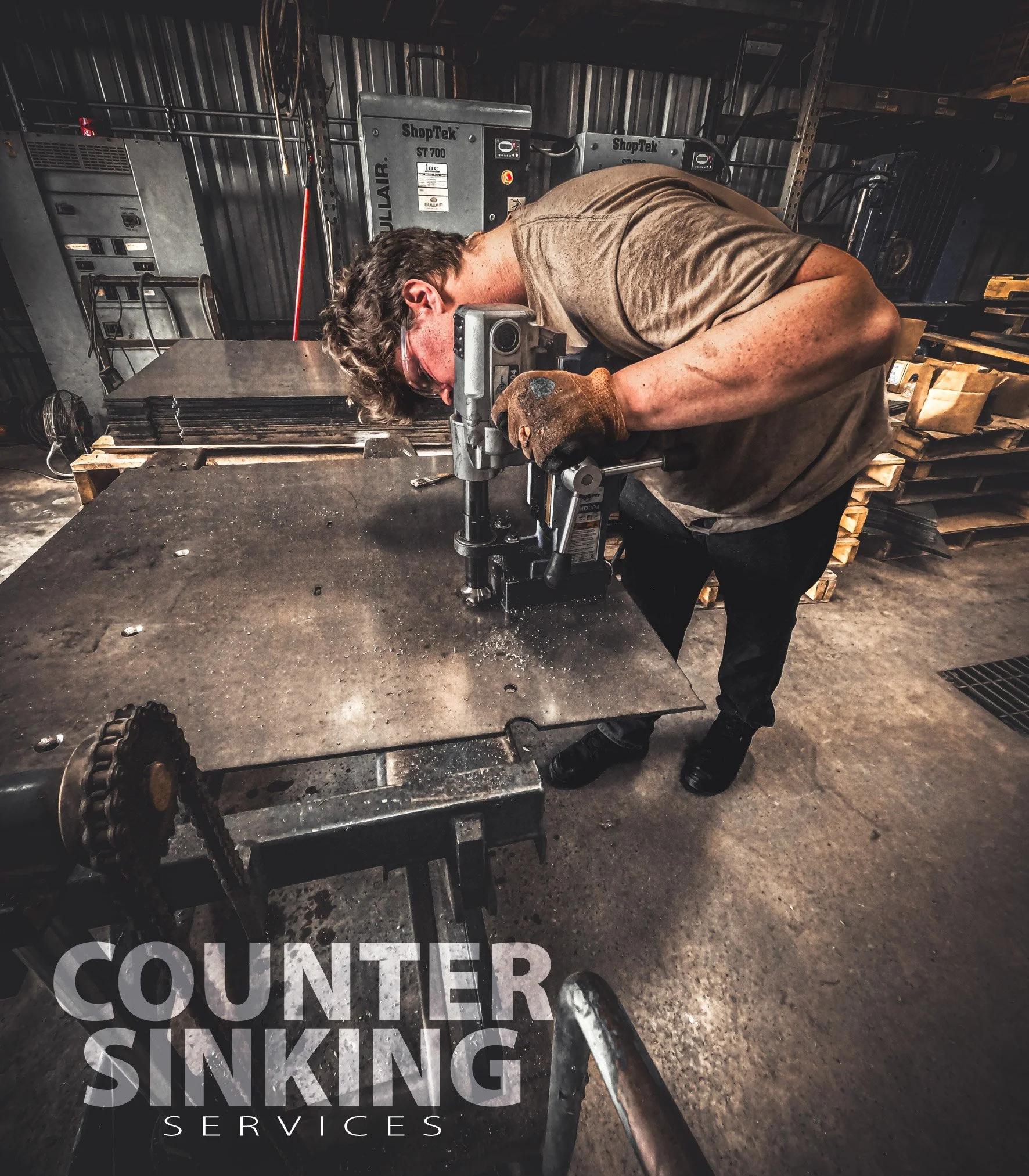
COUNTER
SINKING
COUNTERSINKING
Countersinking
Countersinking is a precision metal fabrication process used to create a conical recess in a pre-drilled hole, allowing flat-head fasteners to sit flush with or slightly below the surface of the material. This process improves appearance, safety, and assembly fit while maintaining part integrity.
How It Works
The countersinking process begins after a hole has been drilled in the material. A countersink cutting tool is then used to remove material from the top of the hole at a controlled angle and depth that matches the fastener head geometry. Cutting speed, feed rate, and tool alignment are carefully managed to produce clean, accurate recesses without chatter or surface damage. Proper setup ensures consistent results across multiple parts and production runs.
Quality & Accuracy
Countersinking delivers uniform recess dimensions, accurate fastener alignment, and consistent surface finish. Tight process control helps maintain dimensional accuracy and prevents over-cutting, which could affect fastener seating or part strength. The process preserves overall part flatness and ensures reliable, repeatable results.
Benefits
Countersinking eliminates protruding fastener heads, improving part safety, appearance, and functionality. It supports clean, professional assemblies and enhances product fit and finish. Suitable for steel, stainless steel, aluminum, and other metals, countersinking integrates seamlessly with drilling and threading operations. This process contributes to efficient assembly, consistent quality, and durable finished components.